Blackjack
- Basic casino rules
- Variants and differences
- Payout cheat sheet
- Dealer glossary
- Test yourself
- In the Croupier Assistant trainer
Object of the game
Blackjack (21) is a card game in which each player plays against the dealer, not against the other players. The goal is to finish with a higher total than the dealer without going over 21. A hand that goes over 21 busts and loses immediately.
If the dealer busts, every player hand still in play wins. If the player and the dealer have the same total, it is a push and the bet is returned to the player.
The rules below are the commonly used ones. Details such as the number of decks, whether the dealer hits soft 17, whether doubling after a split is allowed and whether surrender is offered depend on the casino and are posted at the table.
Cards and hand values
The game is dealt from 1 to 8 standard 52-card decks; casinos most often use a 6- or 8-deck shoe. Suits do not matter.
| Card | Value |
|---|---|
| 2–9 | Face value |
| 10, jack, queen, king | 10 |
| Ace | 1 or 11, whichever is better for the hand |
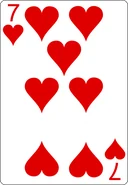
A hand in which an ace counts as 11 without the total exceeding 21 is a soft hand. A soft hand cannot bust with one more card, because the ace simply drops to 1. All other hands are hard hands.
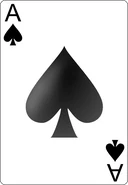
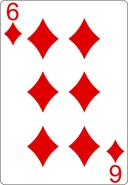 Hard 17
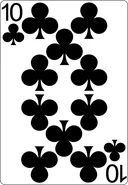
A blackjack (natural) is an ace plus any 10-value card as the first two cards. It is the top hand and beats any other 21 made with three or more cards.
Bets
Before the deal each player places a bet in their betting box within the table minimum and maximum. During the round a double, a split or insurance may be added, and their size depends on the original bet.
- Main bet: placed in the box before the deal.
- Double down: an additional bet equal to the original wager.
- Split: an additional bet equal to the original wager, placed on the second hand.
- Insurance: up to half the original bet, offered only when the dealer shows an ace.
- Many casinos also offer side bets (pairs, three-card poker combinations and so on); their rules and payouts vary from table to table.
How a round is played
- The dealer deals one card clockwise to each box with a bet and one to themselves, then a second card to everyone. Player cards are usually dealt face up.
- One dealer card is face up (the upcard); the other is face down and is called the hole card.
- If the dealer shows an ace, insurance is offered. With an ace or a 10-value card showing, the dealer (in the American game) peeks at the hole card. If the dealer has blackjack, the round ends at once: players without blackjack lose their original bet, and a player blackjack pushes.
- Players act in turn, starting to the dealer's left (first base): hit, stand, double down, split a pair or surrender.
- The dealer then turns over the hole card and draws according to fixed rules, with no choices.
- The dealer compares their hand with every remaining player hand, collects losing bets and pays winners.
Player options
| Option | What happens |
|---|---|
| Hit | The player takes another card and may keep hitting until they stand or bust. |
| Stand | The player takes no more cards and keeps their total. |
| Double down | The player adds a bet equal to the original and receives exactly one more card. Usually allowed on any first two cards; some casinos restrict it to 9, 10 or 11. |
| Split | A pair of equal-rank cards (often any two 10-value cards) is split into two hands, with an equal bet on the second hand. Each hand is played separately. Split aces usually receive only one card each. |
| Surrender | The player gives up the hand and loses half the bet; the other half is returned. Only on the first two cards, and not offered everywhere. |
| Insurance | When the dealer shows an ace: a separate bet of up to half the original wager that the dealer has blackjack. |
A 21 after a split (for example, a ten on a split ace) counts as an ordinary 21, not a blackjack, and pays 1:1.
How many times pairs may be resplit, whether aces may be resplit and whether doubling after a split (DAS) is allowed are set by each casino.
Dealer rules
- The dealer must hit 16 or less and stand on 17 or more.
- Soft 17 (ace plus six and the like): some casinos have the dealer stand (S17), others have the dealer hit (H17). The rule is printed on the table layout.
- The dealer never doubles, splits or surrenders.
European no hole card: the dealer takes a second card only after all players have finished and does not check for blackjack in advance. If the dealer ends up with blackjack, a player who doubled or split usually loses the entire amount wagered, not just the original bet. In the American game a player can lose no more than the original bet to a dealer blackjack.
Payout table
| Outcome | Payout |
|---|---|
| Player blackjack | 3:2 |
| Player blackjack (some tables) | 6:5 |
| Ordinary win | 1:1 |
| Insurance when the dealer has blackjack | 2:1 |
| Push | Bet returned |
| Surrender | Half the bet returned |
| Player and dealer both have blackjack | Push, bet returned |
Pay tables vary between casinos: the classic blackjack payout is 3:2 (a win of 1.5 times the bet), but some tables pay 6:5 (1.2 times the bet). The trainer uses 3:2, and 6:5 appears at the hard and expert levels.
Quick 3:2 calculation: add half the bet to the bet. A bet of 100 wins 150, 250 wins 375, 75 wins 112.5.
6:5 calculation: bet × 1.2. A bet of 100 wins 120, 50 wins 60.
Insurance at 2:1: insurance bet × 2. With an original bet of 100, insurance is up to 50 and wins 100.
Example 1: blackjack
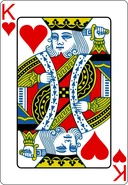 Dealer
The player has blackjack and the dealer does not, so the player is paid 3:2 at once. On a bet of 100 the win is 150 (the player keeps the 100 bet). At a 6:5 table the win would be 120.
Example 2: double down
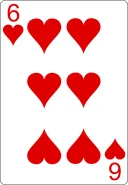
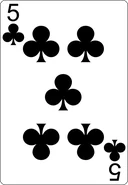
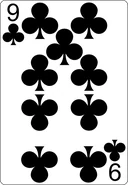
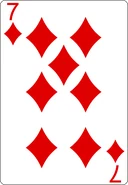
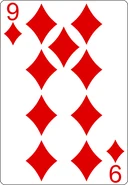 Dealer
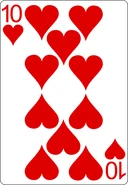
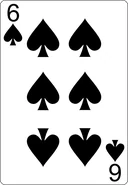
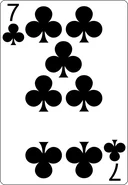
The player bet 100 and doubled, so 200 is in action. The dealer busts and the player wins 1:1 on the full amount: a win of 200.
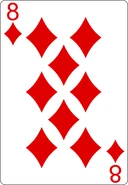
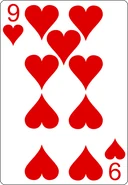
Example 3: split
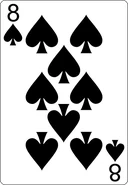
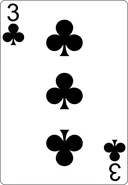
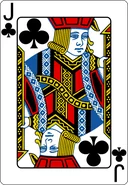 Hand 2
 Dealer
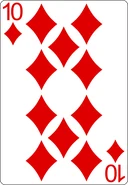
There is 100 on each hand. Hand 1 (21 against 17) wins 100. Hand 2 (17 against 17) pushes and the bet is returned. Total win: 100.
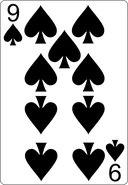
Example 4: insurance
 Dealer
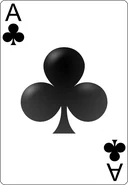
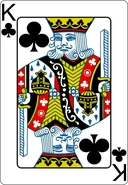
The 100 main bet loses to the dealer blackjack. The 50 insurance bet wins 2:1, which is 100. The player breaks even: 100 lost, 100 won. Had the dealer not had blackjack, the insurance would have lost and the main bet would have been played out as usual.
Rules and pay tables are checked against wizardofodds.com. Casinos may differ — see Variants and differences.
Variants and differences
| Rule | Common version | Where it differs |
|---|---|---|
| Blackjack payout | 3:2 | 6:5 at some tables — the house edge grows by about 1.4% |
| Dealer soft 17 | Dealer stands (S17) | Dealer hits (H17) — about +0.2% for the house |
| Decks | 6–8 decks | 1–2 decks, usually with 6:5 or doubling limits |
| Double down | On any two cards | Only on 9, 10, 11 |
| Double after split | Allowed | Not allowed in some casinos |
| Surrender | Late, not everywhere | Early — rare |
| Dealer's second card | Dealer peeks for blackjack with an ace or ten up (American style) | European style: second card after the players; against a dealer blackjack the player loses doubles and splits too |
Payout cheat sheet
| Bet | Blackjack 3:2 | Blackjack 6:5 | Insurance (½ bet) 2:1 |
|---|---|---|---|
| 10 | 15 | 12 | 10 |
| 20 | 30 | 24 | 20 |
| 25 | 37.5 | 30 | 25 |
| 50 | 75 | 60 | 50 |
| 100 | 150 | 120 | 100 |
| 150 | 225 | 180 | 150 |
| 200 | 300 | 240 | 200 |
A regular win pays 1:1 (equal to the bet). A doubled or split bet is paid on each part separately.
Dealer glossary
- Blackjack (natural)
- An ace and a ten-value card as the first two cards; pays 3:2.
- Hit
- Take another card.
- Stand
- Take no more cards.
- Double down
- Double the bet and receive exactly one card.
- Split
- Split a pair into two hands with an equal bet on the second.
- Soft hand
- A hand where the ace counts as 11 without busting.
- Bust
- Over 21 — the hand loses.
- Push
- A tie; the bet is returned.
- Insurance
- A bet that the dealer has blackjack when the dealer shows an ace; pays 2:1.
- Shoe
- The box the cards of several decks are dealt from.
Test yourself
Three payout questions. Answer with the net win or the amount asked for, not including the bet itself.
Trainer modes for this game: what you calculate and how your answer is checked.
Practice this game